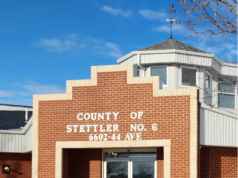


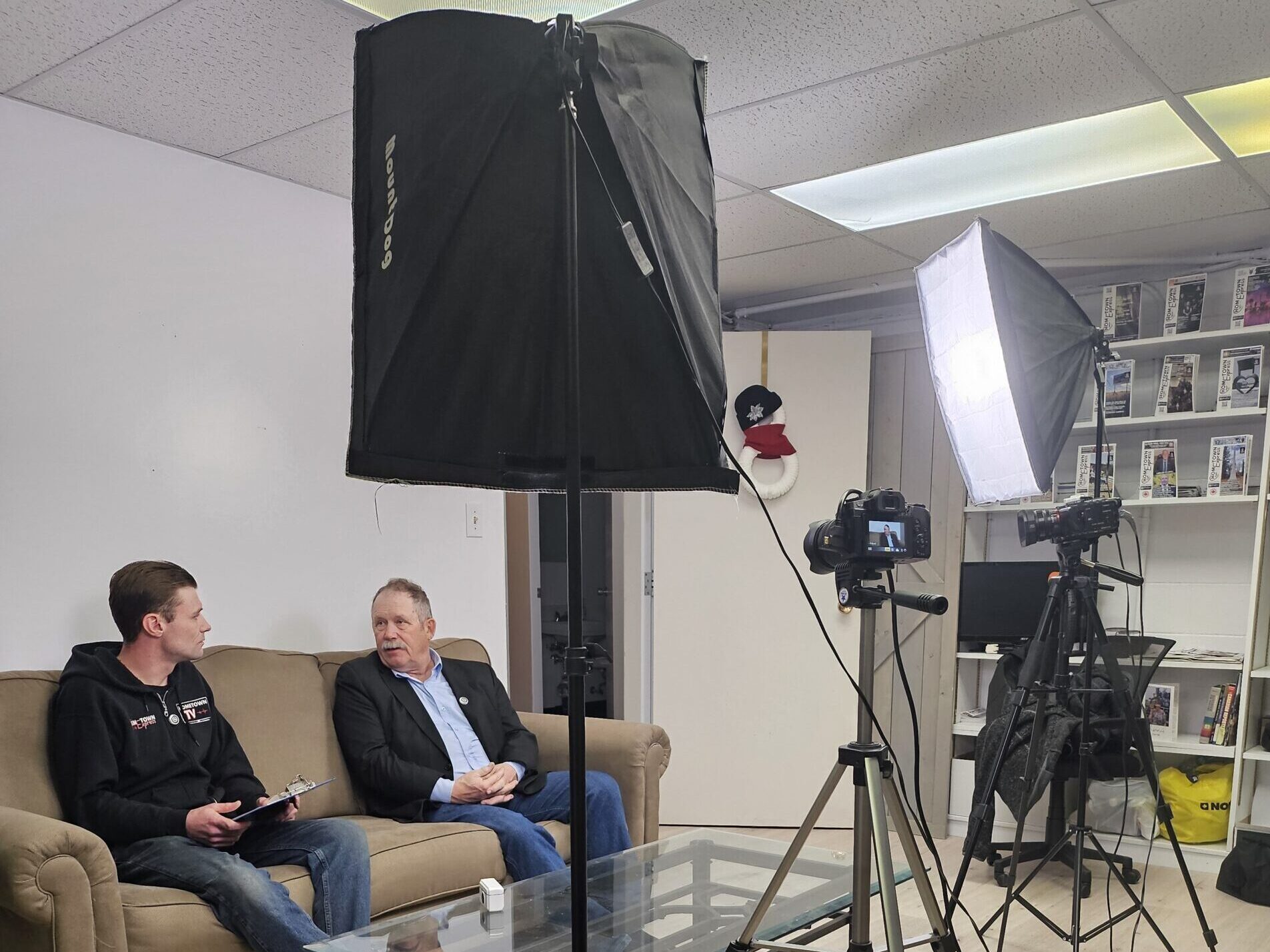
Hometown Productions & Media’s Landin Chambers sat down with County of Stettler Reeve Larry Clarke to talk about recent developments & priorities for the next four years.
Chambers: Larry, first of all, thanks for coming down & chatting with us so close to the holidays.
Clarke: Thank you very much for having me come in.
Chambers: A couple weeks ago, we had new mayor Gord Lawlor in to chat. We figured we’d invite you down for the same.
Clarke: Well, thank you. I appreciate it very much.
Chambers: First off, you were acclaimed for your ward as the only one who ran in Botha/Gadsby, talk about some of the issues that led you to run in the first place & then throw your hat in for another four years.
Clarke: This will be my third term now. The first time I ran, I’d recently retired & had a lot of people running.
Honestly, what a lot of people don’t understand about municipal politics is that you think you’re going to come in & make changes very quickly.
But everything I was coming in with was probably a vision that wasn’t true to be met. Over the last eight years you realize it & there’s changes you can make. But you have to do it in a very controlled fashion.
So I’ve worked with great councils & we’ve moved the ball down the road on a lot of things. This four year term there’s still things that we need to work through.
Some of them I’d like to discuss today & there’s other things that we can discuss in the future too.
Chambers: So as you said you’re on your third term on council now. You were recently elected to serve on the RMA board of directors. Tell me a little bit about the issues you’re dealing with there.
Clarke: The RMA board of directors encompasses the 69 municipalities & in that I’m representing District 2 which is a very large district.
District 2 is a wonderful diverse area that adds a lot to our province. With RMA you lead advocacy with resolutions. That’s one of the big things RMA does is they have an advocacy lobbying group that deals with it from the aspect of all of the rural municipalities.
So just being able to have a bigger voice with a larger group. You know, I knew some of the pieces of RMA, but RMA has another seven companies operating underneath them.
They have Genesis Insurance, which a lot of our municipalities use. Canoe purchasing is also a major purchasing group. So it’s been a lot of training, but some great people up there to work with & some very interesting topics too.
Chambers: We’ve seen the move towards forming an independent fire department with the termination of the intermunicipal fire agreement with the Town of Stettler.
Let’s just go back to the negotiation of that agreement in 2023 & what were some of the issues?
Clarke: In 2023 we came to the point of how the regional fire department should be run, & we did get to the point where we had a stalemate.
The County really wanted to see a commission which the fire commission operates under, which is basically a board of directors & all of your communities have the opportunity to be on the board, with opportunities for members at large.
Then the manager & the fire chief would take direction from that board, not from municipalities. So the Town wished to maintain the structure that we had basically.
So we got to a point where we were having some major issues with volunteers & we needed to make some changes after the 2023 agreement.
There were things we agreed to the 2023 agreement which I take responsibility for. There’s things that we didn’t enforce that we’d agreed to. So in doing that, it may have made the outcome different.
But in the same sense it wasn’t done & we got to a point where our fire manager resigned & I knew we had to act, & when I say I, I mean myself & my council knew we had to do something. So we did, & over the last several months we’ve made those changes.
The County of Stettler council introduced a health spending account for Heartland Regional Fire. How’s that been received during the recruitment process?
Clarke: In all honesty, that was something that was ongoing for quite some time. It fell into line. We did get everything together through our insurance providers so that we could do it.
Another issue was what type of coverage you would provide to your firefighters, because a lot of them might have more than one benefit company. So, we did that so they can use it in addition to any other benefits that they have.
I won’t say it was really for recruitment as much as it was to thank the firefighters that we have. You know they’re going into some very risky situations.
We have a lot of rural people on it too, & it may be their only healthcare. But they can choose where they want to put that money at that point.
It was very well received by the firefighters, but it was something we’ve been talking about for quite some time.
From what we heard at council this month, most of the equipment has arrived for you guys?
Clarke: Yes. I actually just came from the fire hall. We had our county fire service lunch & safety awards. A beautiful facility there. Just before, I had walked through the back & they’ve got their gear washing equipment in place.
There’s maybe one or two small items they’re waiting on to be delivered going into 2026, but all the major things are there & everything looks great.
Chambers: So, fire wasn’t the only issue the County dealt with this year. Water or the lack thereof was another issue.
I know former counselor Paul McKay would speak about the cost of hauling water for his cattle. What have you been hearing on this front?
Clarke: You know, every year drought relies on how much moisture you get in a year. You look at this year, we received moisture when we needed to receive moisture as far as our crops went.
So, our ag. producers fared fairly well. There were some really great crops, in fact record crops this year. But in the same sense, it’s year-over-year the lack of snowfall & the lack of runoff.
We end up to the point where we’re not seeing the potholes & sloughs & dugouts fill up. That’s where our biggest demand for water has been.
People’s sloughs are drying up in most areas of our County. You know if there is water, in a lot of cases it can be a very salty or briny water & the animals don’t like it, or won’t drink it.
It started out in the eastern part of our county & it has moved all the way to the west. If you’ve been to Buffalo Lake, you’ve heard the issues with the water levels in Buffalo Lake that’s affected every slough and every pothole in the pastures there.
We put more water tie-ins up there in the last couple years that have been strictly for watering livestock. So we’re lobbying right now trying to come up with different ways with our government partners & agencies on trying to get more water lines out there.
I’d like to see more transmission lines as well so that we can distribute off of them. So, we’re trying to turn over whatever rock we have to turn over to make people realize how critical this is.
Chambers: A number of communities have come under the county’s jurisdiction over the past decade such as Botha & Gadsby.
Donalda held a vote in 2010, voted against joining the county, but there it’s looking like we have another vote coming next year.
Talk a little bit about that process & just what council’s been hearing from the province?
Clarke: Yeah, Botha & Gadsby are both in my district as a counselor. I’ve seen the steps that have to be taken in order to get the infrastructure up to standards.
We did get through that with Botha. We’re just finishing up in Gadsby now & it’s been five plus years.
Donalda right now is in another viability study through Municipal Affairs. We’ve had conversations with them & with the existing council of Donalda.
If it does go to a vote to go from a village to a hamlet we have to ensure we’ve covered off on what needs to be done for a transition, because it‘s critical to get that in place up front.
So we’ll be working diligently to make sure that the people that are there, if they can run on their own, that’s wonderful. If they want to make it work, we’ll do what we can to help them make it work as a municipal partner.
But in the same sense, if we’re going to take it over, we need to make sure that the infrastructure is in place for longevity.
Chambers: So, as you said, it’s just at the survey point right now?
Clarke: Nothing’s been determined yet. No. Municipal Affairs is involved. They’ve talked to both us & to the village of Donalda.
Chambers: Finally, the council recently learned about the AUC approval of the Stettler Solar & Storage project. Construction is set to start in 2027 if development permits are approved.
We also have a second larger project at Red Willow being considered. The county initially opposed these projects, but will now have input at the permitting stage here?
Clarke: Yes, and we actually have had input already in the permitting stages because part of the appeal process was based on what was in permits.
So yeah. We’ll be enforcing the permits as we work through it. Green energy projects are really pushing for rural areas right now. You see it throughout all of Alberta.
It’s beneficial to some individuals, probably beneficial to Albertans, but also North Americans, but in the same sense neighbors may have varying ideas on it.
So, as a as a development authority, we have to work through it with the AUC & the surrounding land owners to try & come up with something that is acceptable to all parties.
But you get the quasi-judicial system such as the AUC on this, & they’ve been good to deal with through the hearings & everything else.
But the final say really falls back into their court. All you can do is present the issues at hand, & work through the process & then they come up with a decision.
So the AUC has decided these will go forward. So we need to work to make sure that what was agreed too is done & try to minimize effects to nearby residences, & then try to put the best systems in place we can for our County.
Chambers: Just ensuring that the glare isn’t there on the road & that emergency plans are in place?
Clarke: Yeah, and the emergency plans are a big thing. Weed control is another big thing. You know, some of these projects as you go through different municipalities take up quarter sections of land.
My worry too is it can be taking that land out of food production for people too. It’s on agricultural land.
Chambers: So, is there anything else today that you’d like to mention?
Clarke: I just would like to say to the fact, we’re a relatively new council. We’ve got four out of the seven individuals who are new, but we’ve been through the orientations.
We’ve been through a lot of our first meetings, so things are moving forward. We’ve worked very hard on the 2026 budget. We approved our interim budget & I believe in early January we’re doing the public consultation on our 2026 budget.
So another good bunch of people to work with. We’ve got a great staff to work with & we just need to be moving forward.
One thing we didn’t comment on which I’d like too is on doctors. Our doctor recruitment truly showed what our community does as a community.
With Stettler Needs Doctors & with the different groups, the Stettler Health Foundation, the County, the Town, we’ve shown what we can do with that.
We need to continue moving forward on those positives & I look forward to what 2026 brings to our health care & our hospital. We will have anesthesiologists in place & it should bring us back to where we should be with a community this size.
Chambers: I’d like to say thanks again for coming to sit down with us & thank you all for watching & all the best to you & your family this holiday season.
Clarke: Thank you & a very Merry Christmas to all of you.

Author: Landin Chambers
Landin Chambers is a news reporter for Hometown Media Stettler. He has a background in broadcast news, with previous roles in Prince George, Red Deer and Calgary. You may also see him as a cameraman for the Stettler Wildcats and Stettler Imperials. Have a story idea? Email: lchambers@htproductionsmedia.ca