


Albertans head to the polls on Monday, October 19th, to cast their ballots in a provincewide referendum on ten questions ranging from immigration policy to Alberta’s future within Confederation.
Voting locations on Election Day will be open from 9 a.m. to 8 p.m. Unlike advance voting, you must vote at your assigned polling station.
Be sure to bring a valid ID showing your name and current address.
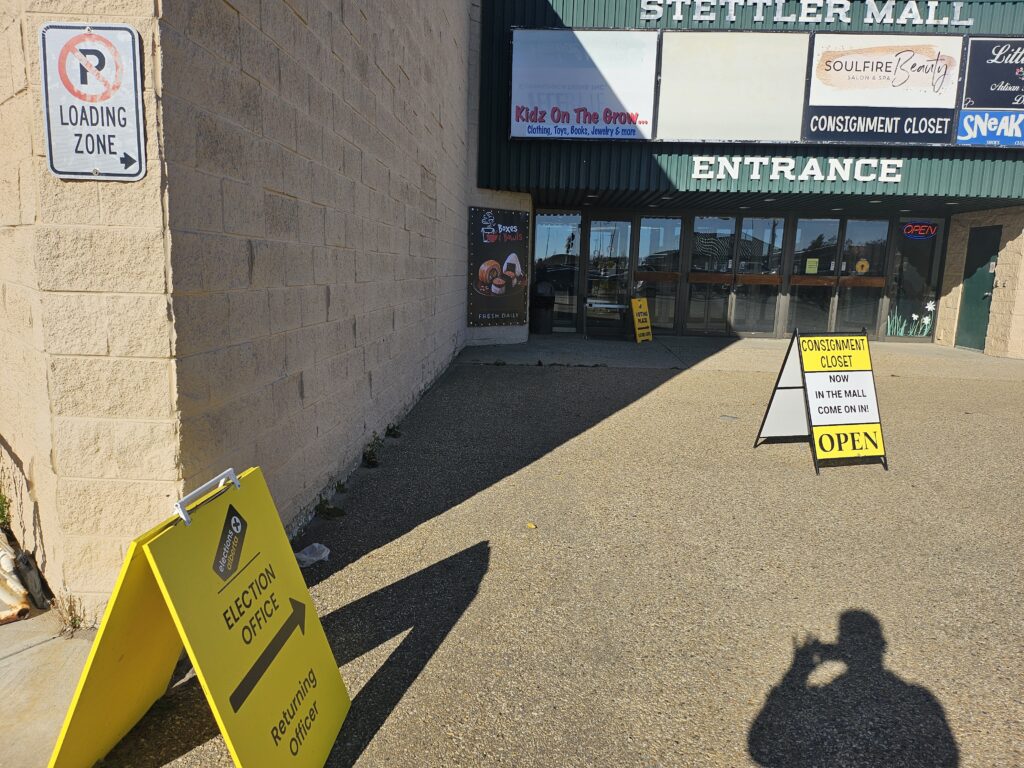
Note that advance voting in Stettler takes place at the Stettler Mall, while voting moves to the Stettler Community Hall on October 19.
Under provincial law, all employees are entitled to three consecutive hours off work to vote while polls are open.
Early results on Question 10 are expected shortly after polls close Monday evening, with official confirmation set for October 29th.
Additional Info Provided By Elections Alberta
Vote in Advance
Electors who are unable to vote on Election Day should consider voting during one of the five advance voting days October 13-17 or voting by mail.
Voting on Election Day
On Election Day you must vote at your designated voting place.
This location will be listed on your Where to Vote card mailed to your residence or can be found by entering your physical address information in the Where to Vote website.

When you enter the voting place, you will be greeted by an information officer.
They will ask if you have identification with your full name and physical address and determine if you are registered to vote.
If you do not have identification, the information officer can help you identify options for proving your identity and physical address. This may include having an attestation form signed by an authorized signatory.
If you are already registered to vote, you will be directed to your assigned voting station, where the Voting Officer will look at your identification, confirm the address listed on your identification matches the address in the voting record, confirm you are eligible to vote, and issue you a ballot.
If you are registered to vote at the correct physical address but have a mailing address on your identification that is not listed in the voting record, you will need to confirm your identity and current residential address by signing a declaration.
If you are not registered to vote and have identification, you will be directed to the registration station. The Registration Officer will look at your identification, prepare a declaration for you to sign, and issue you a ballot.
Questions on the Ballots
Each question will be on a separate numbered and colour-coded ballot (except if you are voting by mail. Vote by mail ballots are all white).
Electors will receive their ballots in the order they appear below.
Question 10 is a choice question between two options. Electors will select one choice only.
Questions 1-9 are yes/no questions. Electors will mark either “yes” or “no” on their ballots.
As set out in the Orders in Council, the ten referendum questions to be put to the electors are as follows.
Should Alberta remain a province of Canada, or should the Government of Alberta commence the legal process required under the Canadian Constitution to hold a binding provincial referendum on whether or not Alberta should separate from Canada?
Option 1: Alberta should remain a province of Canada.
Option 2: The Government of Alberta should commence the legal process required under the Canadian Constitution to hold a binding provincial referendum on whether or not Alberta should separate from Canada.
The following questions and orders the results of the referendum on these questions are not to be binding. Electors will mark either “yes” or “no” for each question on their ballots.
- Do you support the Government of Alberta taking increased control over immigration for the purposes of decreasing immigration to more sustainable levels, prioritizing economic migration and giving Albertans first priority on new employment opportunities?
2. Do you support the Government of Alberta introducing a law mandating that only Canadian citizens, permanent residents and individuals with an Alberta approved immigration status will be eligible for provincially-funded programs, such as health care, education and other social services?
3. Assuming that all Canadian citizens and permanent residents continue to qualify for social support programs as they do now, do you support the Government of Alberta introducing a law requiring all individuals with a non-permanent legal immigration status to reside in Alberta for at least 12 months before qualifying for any provincially-funded social support programs?
4. Assuming that all Canadian citizens and permanent residents continue to qualify for public health care and education as they do now, do you support the Government of Alberta charging a reasonable fee or premium to individuals with a non-permanent immigration status living in Alberta for their and their family’s use of the healthcare and education systems?
5. Do you support the Government of Alberta introducing a law requiring individuals to provide proof of citizenship, such as a passport, birth certificate or citizenship card, to vote in an Alberta provincial election?
O.C. 109/2026 sets out the following constitutional questions. Electors will mark either “yes” or “no” for each question on their ballots:
6. Do you support the Government of Alberta working with the governments of other willing provinces to amend the Canadian Constitution to have provincial governments, and not the federal government, select the justices appointed to provincial King’s Bench and Appeal courts?
7. Do you support the Government of Alberta working with the governments of other willing provinces to amend the Canadian Constitution to abolish the unelected federal Senate?
8. Do you support the Government of Alberta working with the governments of other willing provinces to amend the Canadian Constitution to allow provinces to opt out of federal programs that intrude on provincial jurisdiction such as health care, education, and social services, without a province losing any of the associated federal funding for use in its social programs?
9. Do you support the Government of Alberta working with the governments of other willing provinces to amend the Canadian Constitution to better protect provincial rights from federal interference by giving a province’s laws dealing with provincial or shared areas of constitutional jurisdiction priority over federal laws when the province’s laws and federal laws conflict?
The Election Act, and regulations under the Election Act, apply to the conduct of the referendum.
Important: Elections Alberta may not interpret the questions provided by the Government of Alberta above. Any questions about what each question means should be directed to the Government of Alberta or your MLA. You can find your MLA and their contact information by using the Find My MLA application on our website.
Results
The unofficial count of Election Day ballots is completed after voting closes on Monday, October 19. The count for advance voting and special ballots begins at 5:00pm on October 19.
Ballots will be counted by hand and results reported in the order above. This means Question 10 will be counted first at each voting location and station.
Once a counting station has completed the count for a question, they will move on to count the next question in order.
Results will be published on Elections Alberta’s results website as they are received from returning officers.
Unofficial results will be available at https://www.elections.ab.ca/elections/election-results/ as counts are completed, by question, by elector division, and by voting method. The count must be completed within 48 hours of close of voting.
In the days following Election Day, returning office staff review the materials from the unofficial count to verify the results. These confirmations are then reported as official results and released to the public.
This is known as the Official Announcement of the Results and will take place on October 29 at 10:00 am.
Referendum Scrutineers
Scrutineers are permitted for a referendum for each official party and each proponent for a question arising from a successful citizen initiative petition.
Appointments must be made in writing to the Chief Electoral Officer no later than 8 weeks before Election Day.
Additional scrutineers may be permitted for third party advertisers representing a Yes or No position or choice position on the referendum questions.
Contact Us
Need additional information? Contact the returning office or Elections Alberta.

Author: Landin Chambers
Landin Chambers is a news reporter for Hometown Media Stettler. He has a background in broadcast news, with previous roles in Prince George, Red Deer and Calgary. You may also see him as a cameraman for the Stettler Wildcats and Stettler Imperials. Have a story idea? Email: lchambers@htproductionsmedia.ca